Bad weather and my work schedule have kept me from doing much observing at all. I haven't made any variable star brightness estimates since 2013 began. However, I have managed to get the 10" f/4 outside several times to do some Lunar Observing and Photography.
A good opportunity to do more of this came on Friday evening, March 29 - Saturday morning, March 30. The Moon this night was almost three full days past Full and was due to rise around 11:00 PM EDT. What made this really interesting was that I had the chance to observe and photograph the Mare Crisium Sunset Ray (my own name for it) after midnight when the Moon rose high enough to be seen from my back yard. I hadn't seen this phenomenon for years; since it only happens for a few hours each lunar cycle. This "sunset ray" occurs when the mountains that surround the area of Mare Crisium cast a shadow over most of the plain itself, but one gap in those mountains, near the crater Tebbutt, lets the low sun keep shining through. This makes a long ray of sunlight visible on the Mare floor for several hours before the sun sets behind those mountains and Mare Crisium is in complete shadow. I've seen it a few times and sketched it, but never had the opportunity to try to photograph it.
The Moon was so low in the sky tonight, and there are so many trees to my south, that I only had a short window of time to look at it before it was blocked by the tree branches. It was a chilly night but not as cold as most of the nights have been. It was about 40 degrees F with light winds. I still bundled up in a winter coat. There were only small patches of snow here and there on the ground around me; the last leftovers from the late season winter storm that moved through our area six days ago.
I set the 10" f/4 telescope outside before midnight to let the optics cool down. The Moon was visible over the roof of a house to my south by 12:30 AM. I observed and photographed it for an hour between 12:45 AM - 1:45 AM. Unfortunately, the short window of time where the Mare Crisium Sunset Ray would have been visible was already past. The entire Mare was in shadow and only the lit-up mountains that surround this big flat lava plain were in sunlight. Still, I was able to get a lot of great looks at this and other features with my eye, and I was able to snap a lot of photos. Some of them turned out to be pretty clear, though I wouldn't call any of them spectacular.
My primitive method for imaging the Moon hasn't changed in the last couple of years, but I'm getting better at it. I use a cheap Nikon Coolpix digital camera held up to the eyepiece. This camera has a nice screen on the back, and as I hold the lens to the eyepiece I can usually get it in focus looking at the back screen. Then, as the Moon glides through the field of view of the eyepiece (since my telescope tracking hasn't worked for two years!) I just keep snapping photos every few seconds. When I'm done I download them to the computer and just sort through the displayed images, weeding out the awful ones from the clearer ones. (I haven't actually deleted any images yet, though, since one never knows if even a bad image might hold some good data!)
Here's an image of the whole Moon taken at 12:47 AM EDT March 30. It isn't a great image, but it gives a good idea of how the Moon phase was that night. The Moon was never higher than 25 degrees up in the Southeast sky, so it had a definite yellowish color to it when I was observing it, having to shine through the thicker atmosphere layers closer to the horizon. This was taken using 39X on the 10" telescope.
Here's an enlarged image of the limb of the Moon that was starting to go into shadow, so it shows the area of the Moon experiencing sunset. Mare Crisium is in almost complete shadow near the center at the bottom, but the mountains that ring it's western edge are still in sunlight. This photo turned out much better than I thought it would, showing a lot of detail. It was taken at 1:38 AM March 30.
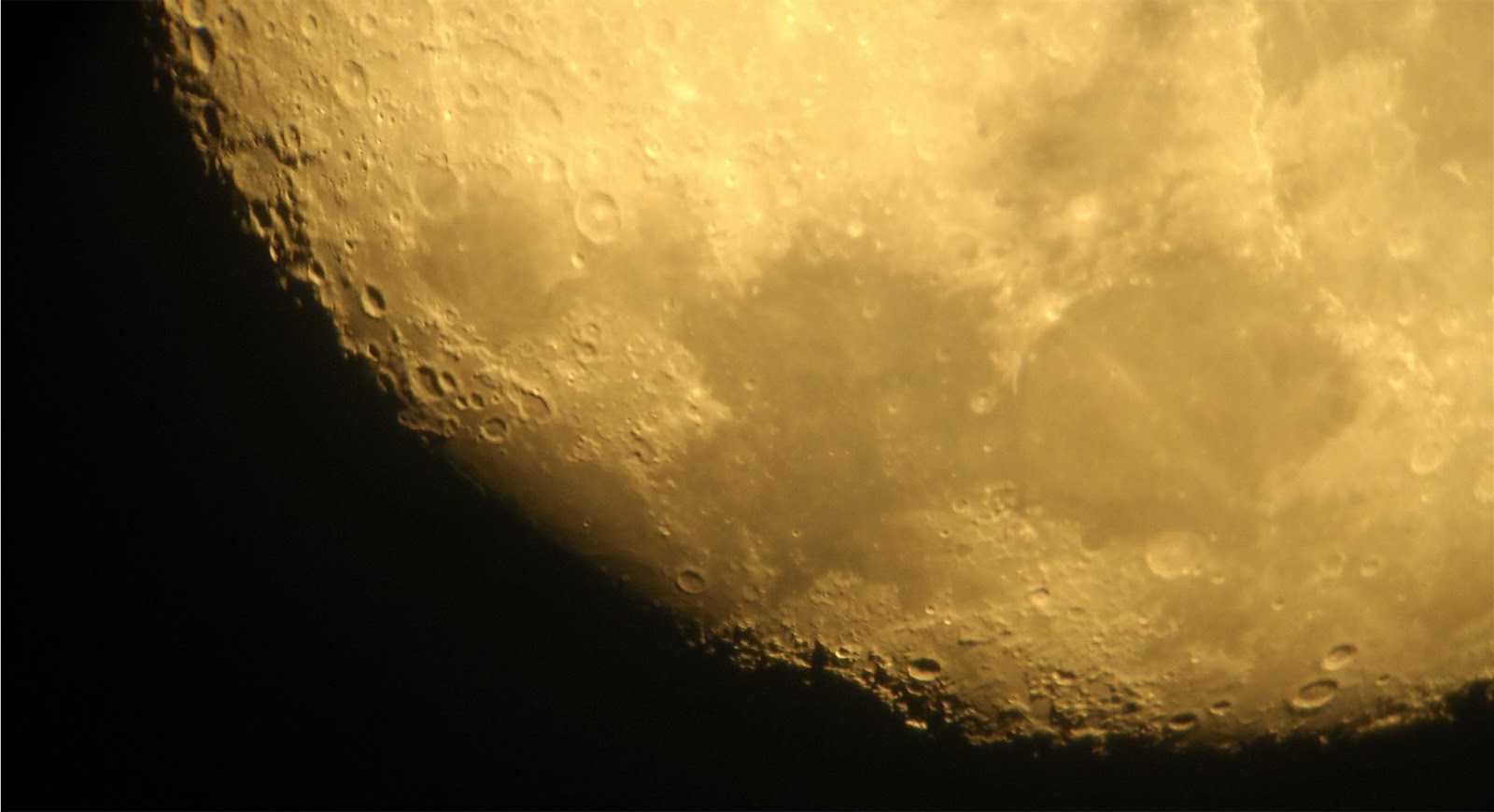
Finally, here's a blow-up of the same photo as above, showing the edge of Mare Crisium in shadow and the mountain ring around one edge still illuminated by the sunlight. There was one prominent spot still lit up by the sun within Mare Crisium, and my best guess is that this was part of the edge of the crater Yerkes that lies on the floor of the Mare, but I could be wrong about this.
Besides just trying to take some "pretty photos" I did a lot of observing of the crater Aristarchus this night, and imaged it. This was as part of the Repeat Illumination Event Projects done by the ALPO (Association of Lunar and Planetary Observers) Lunar Section and by the TLP (Transient Lunar Phenomena) section of the British Astronomical Association. I'll cover the Aristarchus work done this night in a later post.
Amateur Astronomy / Weather / Other Observations from Southeast Marion County (Indianapolis) Indiana.
Wednesday, April 3, 2013
Sunday, August 19, 2012
Orion Observing Season Has Arrived
It's pretty obvious from the lack of entries that I haven't been doing much observing. I actually haven't had the telescope outside since the end of March, almost five months ago. I haven't reported any variable star estimates during that entire time, either. Working a job that has me alternating between morning / afternoon and afternoon / late night shifts, every two weeks, hasn't helped my hobby much! Getting in quality observing time during the short summer nights also hasn't been easy with that schedule. I'm hoping that all of that will change soon.
For the last two weeks I'd been making the 40 mile drive to work between 5:15 AM - 6:00 AM. By the middle of that drive the first hint of dawn had been showing in the east, and by the time I'd arrived it was starting to get light outside but was still dark enough for a lot of stars to be seen. I was treated to great views of Jupiter blazing away in Taurus and Venus much lower in the east in Gemini, but what really made those morning drives memorable were the views I had of my favorite constellation rising over the east-southeast horizon, Orion. This great collection of bright stars would clear the horizon just as dawn was breaking. It reminded me that the new season for looking at the variable stars in this constellation had officially begun!
Orion is more than an awesome sight in the sky to me. The reason why it contains so many bright stars packed into one area of the sky is because we're looking at a region of our galaxy where giant, white-hot stars are being born from gas and dust clouds. Many of the stars that we can see are just millions - not billions - of years old, and this constellation is absolutely packed with interesting variables! There are dozens of YSO's (Young Stellar Objects)to be watched here. Some of them are difficult objects since they lie within the glow of the Great Orion Nebula M-42 (the fuzzy-looking glow in the middle of the "Sword of Orion") and estimating their brightness is tricky. But many others lie away from that glow, and they can show rapid changes.
Young Stellar Objects are, to put it simply, new-born stars. They're in the last stages of condensing from the gas and dust clouds that collapsed under gravity to form them. They show brightness changes for different reasons and not all of these are well-understood. It's thought that many of these stars still have rings of gas and dust circling them, and when a "glob" of this matter passes between the star's disk and our line of sight, the star seems to fade away and re-brighten. Some observers have reported deep fades and re-brightenings in just hours. I'd love to catch one in the act of doing this! It's also theorized that some of the gas and dust falls onto the surface of the star and ignites it, making it appear to get brighter rapidly to us. There may also be giant star-spots on the surfaces of these stars (like giant versions of sunspots on our Sun) that rotate in and out of view as the star spins on its axis. You just never know what to expect, night after night, when you observe the YSO's in this constellation!
My favorite YSO in Orion so far is UX Orionis. I've been watching this star off and on for three years, and I've seen it brighten from 8th magnitude (very easy to see in my 10" scope) and then dim to 12th magnitude (much more difficult to make out through the 10" telescope). It's done this trick in a two week span of time before, and whether it gets brighter or dimmer from one night to the next is unpredictable. UX Orionis lies just a few degrees northwest of the bright star Rigel. The Orion Nebula M-42 has dozens of stars like this, but the one to watch to me is T Orionis. Also, just to the west of the Belt of Orion there is a very under-observed star called NSV 1960. I haven't been able to find much information about it through internet searches, but the AAVSO Website gives it a wide range in brightness and not much else to back this information up. I'm going to try to make NSV 1960 a priority target this season.
YSO brightness estimates are valuable since these stars are so poorly understood, and only a dozen or so amateurs in the world seem to be watching them systematically. Now that I'm going to be up late at night (instead of getting up early) for the rest of August, I'm hoping that some pre-dawn observing of the Orion YSO stars will be especially valuable to researchers. I'm also hoping that this re-starts my amateur astronomy hobby after being away from the telescope for all these months.
For the last two weeks I'd been making the 40 mile drive to work between 5:15 AM - 6:00 AM. By the middle of that drive the first hint of dawn had been showing in the east, and by the time I'd arrived it was starting to get light outside but was still dark enough for a lot of stars to be seen. I was treated to great views of Jupiter blazing away in Taurus and Venus much lower in the east in Gemini, but what really made those morning drives memorable were the views I had of my favorite constellation rising over the east-southeast horizon, Orion. This great collection of bright stars would clear the horizon just as dawn was breaking. It reminded me that the new season for looking at the variable stars in this constellation had officially begun!
Orion is more than an awesome sight in the sky to me. The reason why it contains so many bright stars packed into one area of the sky is because we're looking at a region of our galaxy where giant, white-hot stars are being born from gas and dust clouds. Many of the stars that we can see are just millions - not billions - of years old, and this constellation is absolutely packed with interesting variables! There are dozens of YSO's (Young Stellar Objects)to be watched here. Some of them are difficult objects since they lie within the glow of the Great Orion Nebula M-42 (the fuzzy-looking glow in the middle of the "Sword of Orion") and estimating their brightness is tricky. But many others lie away from that glow, and they can show rapid changes.
Young Stellar Objects are, to put it simply, new-born stars. They're in the last stages of condensing from the gas and dust clouds that collapsed under gravity to form them. They show brightness changes for different reasons and not all of these are well-understood. It's thought that many of these stars still have rings of gas and dust circling them, and when a "glob" of this matter passes between the star's disk and our line of sight, the star seems to fade away and re-brighten. Some observers have reported deep fades and re-brightenings in just hours. I'd love to catch one in the act of doing this! It's also theorized that some of the gas and dust falls onto the surface of the star and ignites it, making it appear to get brighter rapidly to us. There may also be giant star-spots on the surfaces of these stars (like giant versions of sunspots on our Sun) that rotate in and out of view as the star spins on its axis. You just never know what to expect, night after night, when you observe the YSO's in this constellation!
My favorite YSO in Orion so far is UX Orionis. I've been watching this star off and on for three years, and I've seen it brighten from 8th magnitude (very easy to see in my 10" scope) and then dim to 12th magnitude (much more difficult to make out through the 10" telescope). It's done this trick in a two week span of time before, and whether it gets brighter or dimmer from one night to the next is unpredictable. UX Orionis lies just a few degrees northwest of the bright star Rigel. The Orion Nebula M-42 has dozens of stars like this, but the one to watch to me is T Orionis. Also, just to the west of the Belt of Orion there is a very under-observed star called NSV 1960. I haven't been able to find much information about it through internet searches, but the AAVSO Website gives it a wide range in brightness and not much else to back this information up. I'm going to try to make NSV 1960 a priority target this season.
YSO brightness estimates are valuable since these stars are so poorly understood, and only a dozen or so amateurs in the world seem to be watching them systematically. Now that I'm going to be up late at night (instead of getting up early) for the rest of August, I'm hoping that some pre-dawn observing of the Orion YSO stars will be especially valuable to researchers. I'm also hoping that this re-starts my amateur astronomy hobby after being away from the telescope for all these months.
Sunday, March 11, 2012
PM Sun. February 26 - AM Mon. February 27, 2012 - Observing Notes
This was just the 2nd night out in 2012 with the 10" f/4. This was also an opportunity to observe two fast-changing stars at one time. I'd made some estimates of the RRab type star RR Leonis the first time I'd been out with the scope on January 28th, but tonight I could take a second "crack" at it. The AAVSO Website link had a prediction that this star would peak in brightness around 10:20 PM EST (3:20 UT Feb. 27). Along with this, an Eclipsing Binary Star I'd never observed before, sitting just about 7 degrees away from the first variable, was predicted to be at mid-eclipse around 11:30 PM EST (4:30 UT Feb. 27).
It was an extremely clear and cool night. At dusk, I went outside to catch a glimpse of the Chinese Space Station Tiangong-1. It had been predicted to pass almost overhead from my location at about 7:21 PM, just as skies were getting dark enough to see a lot of stars. Adrian went out to look for it with me. We saw a satellite pass from west to east and thought this must be Tiangong-1. It seemed to be on the same path as the Station was supposed to be moving along. However, this satellite was only about 2.0 magnitude or dimmer and it was going through the sky about a minute or less before the Station was supposed to appear. Then, before the first satellite vanished into the Earth's shadow, we spotted a brighter object moving along the predicted path, about 1.0 magnitude in brightness (about as bright as the brightest stars we could see but much dimmer than the star Capella nearby). This second object had to be Tiangong-1, but it left us wondering what the first object had been. I'll try to research it soon.
I should also write that the Moon was a nice, bright Waxing Crescent high in the western sky at dusk through the start of the night. It was paired with blazing Jupiter, while an even more blazing Venus sat lower in the sky below them. These three solar system objects were a really pretty sight!
I had the 10" f/4 outside and started observing just before 9:00 PM. I ended the session just after 1:00 AM. During that time I was usually moving the telescope back and forth between the two variable stars in Leo, RR Leonis and Y Leonis, and writing down my magnitude estimates and times for them. I took several breaks because even though this wasn't a super-cold night, it wasn't mild either! The temperature went from about 43F to 39F during that time but the wind chills were near the freezing point. There was a noticeable breeze the whole time I was out there. My fingers felt numb and painful so I kept going back inside to warm them up.
To make a long entry shorter, I ended up making 13 estimates for Y Leonis and 14 for RR Leonis during these hours outside. Y Leonis faded to the point where I could barely see it even through the 10" scope, but I was also able to catch it getting brighter again. I figure mid-eclipse must have happened around 11:18 PM (4:18 UT February 27) but this could be off by several minutes. RR Leonis was about an hour behind the predictions, just as it had been during the time I observed it at the end of January. It slowly brightened between 9:00 PM to 11:00 PM, but then it really took off and climbed in brightness between 11:00 and 11:30 PM. I reported these estimates and times to the AAVSO.
I also had my first glimpse of the area of T Bootis before ending tonight, and estimated it to be less than 12.5 magnitude. I had to settle, as always, for a negative estimate for this star, because it wasn't visible (no one has seen it since Baxendell in 1860!). I also made a negative estimate for the nearby cataclysmic variable UZ Bootis. This star last flared up, I believe, in 2002.
I've added the light curves observed tonight for both RR Leonis and Y Leonis, generated using the AAVSO Light Curve Generator. Y Leonis is a type EA/SD + DSCT star which dims out once every 1.686102 days (1 day 16 hours 27 minutes 59.2 seconds) as a much dimmer star, in orbit around a brighter one, crosses in front of it along our line of sight. RR Leonis brightens and dims with a fast period once every 0.4523999 days (10 hours 51 minutes 27.3 seconds) as it expands and contracts.
It was an extremely clear and cool night. At dusk, I went outside to catch a glimpse of the Chinese Space Station Tiangong-1. It had been predicted to pass almost overhead from my location at about 7:21 PM, just as skies were getting dark enough to see a lot of stars. Adrian went out to look for it with me. We saw a satellite pass from west to east and thought this must be Tiangong-1. It seemed to be on the same path as the Station was supposed to be moving along. However, this satellite was only about 2.0 magnitude or dimmer and it was going through the sky about a minute or less before the Station was supposed to appear. Then, before the first satellite vanished into the Earth's shadow, we spotted a brighter object moving along the predicted path, about 1.0 magnitude in brightness (about as bright as the brightest stars we could see but much dimmer than the star Capella nearby). This second object had to be Tiangong-1, but it left us wondering what the first object had been. I'll try to research it soon.
I should also write that the Moon was a nice, bright Waxing Crescent high in the western sky at dusk through the start of the night. It was paired with blazing Jupiter, while an even more blazing Venus sat lower in the sky below them. These three solar system objects were a really pretty sight!
I had the 10" f/4 outside and started observing just before 9:00 PM. I ended the session just after 1:00 AM. During that time I was usually moving the telescope back and forth between the two variable stars in Leo, RR Leonis and Y Leonis, and writing down my magnitude estimates and times for them. I took several breaks because even though this wasn't a super-cold night, it wasn't mild either! The temperature went from about 43F to 39F during that time but the wind chills were near the freezing point. There was a noticeable breeze the whole time I was out there. My fingers felt numb and painful so I kept going back inside to warm them up.
To make a long entry shorter, I ended up making 13 estimates for Y Leonis and 14 for RR Leonis during these hours outside. Y Leonis faded to the point where I could barely see it even through the 10" scope, but I was also able to catch it getting brighter again. I figure mid-eclipse must have happened around 11:18 PM (4:18 UT February 27) but this could be off by several minutes. RR Leonis was about an hour behind the predictions, just as it had been during the time I observed it at the end of January. It slowly brightened between 9:00 PM to 11:00 PM, but then it really took off and climbed in brightness between 11:00 and 11:30 PM. I reported these estimates and times to the AAVSO.
I also had my first glimpse of the area of T Bootis before ending tonight, and estimated it to be less than 12.5 magnitude. I had to settle, as always, for a negative estimate for this star, because it wasn't visible (no one has seen it since Baxendell in 1860!). I also made a negative estimate for the nearby cataclysmic variable UZ Bootis. This star last flared up, I believe, in 2002.
I've added the light curves observed tonight for both RR Leonis and Y Leonis, generated using the AAVSO Light Curve Generator. Y Leonis is a type EA/SD + DSCT star which dims out once every 1.686102 days (1 day 16 hours 27 minutes 59.2 seconds) as a much dimmer star, in orbit around a brighter one, crosses in front of it along our line of sight. RR Leonis brightens and dims with a fast period once every 0.4523999 days (10 hours 51 minutes 27.3 seconds) as it expands and contracts.
Sunday, January 29, 2012
PM Sat. January 28th - AM Sunday January 29th, 2012 - RR Leonis Observations
Indianapolis was between two "clipper systems" on Saturday evening, January 28th. Skies were clear at sunset and dusk. I've been meaning to try making visual brightness estimates for large amplitude RR Lyrae stars for the past couple of months, and a link from the AAVSO web site predicted a peak for the RRab-type star RR Leonis at 11:30 PM local time.
RR Lyrae variables are characterized by rapid cycles of brightening and dimming. Most of them go through a cycle in about half a day and have a range of about one magnitude. RR Leonis is easy to find since it's only a couple of degrees west of the fairly bright star Zeta Leonis in the "Sickle of Leo." This star has a period of 0.4523999 days (10 hours, 51 minutes, and 27.35 seconds) and ranges between 9.9 - 11.3 V magnitude. It should have shown a quick rise from a fairly faint star in my 10" telescope to an easy to see star in about 90 minutes. Visual estimates of this type of variable are often frowned upon by professional astronomers. They prefer CCD imaging, which is much more accurate. However, I'd also recently read through email lists that a lot of these stars go for months with no CCD brightness measurements and that visual observers like me can fill in some "gaps" with the data for RR Lyr stars. This caught my interest and this was my first chance to see if I could contribute any useful data to the AAVSO.
Conditions outside tonight weren't terrible for late January but they weren't too comfortable either! It was very clear at the start of my session but more and more high clouds started to drift in from the north as the night went on. The Waxing Crescent Moon was low in the west and set around 11:35 PM so there wasn't much moonlight interference. Temperatures were at the freezing point or just below it, but there was a steady breeze from the southwest. This added a wind chill that felt about ten degrees colder than the air temperature! There were thin patches of snow here and there on the grass in the back yard. I was bundled up as much as possible and I also had hand-warmers tucked into my gloves, but I had to take breaks every now and then to go back in the house and warm up. I also had to drag out the patio table umbrella tonight and leave it half open to block light from our neighbors' porch lamp to my south, which seems to burn all night and day!
I had the 10" f/4 telescope set up on the back patio by 9:45 PM and started observing RR Leonis just after 10:00 PM. At first I thought that it wasn't going to get as bright as I thought from the amplitude that had been listed for it. Between 10:00 PM and just before midnight I only noticed it getting about 0.3 magnitude brighter. I also wondered if I'd mis-read the prediction table. 11:30 PM was the rough time that RR Leonis was supposed to reach its brightest point, but that time came and went with very little change observed.
I took a break inside the house for half an hour, and when I went back out to look at RR Leonis through the telescope I had a jaw-dropping surprise. Sometime during that half hour between almost midnight and 12:26 AM, the star had surged in brightness. I was now seeing it clearly brighter than the nearby 10.4 magnitude comparison star on the chart, and for the two hours before midnight it had always been noticeably dimmer than this star. I checked and double-checked, but there was no doubt in my mind about this. The prediction on the web site link must have been off by an hour.
I'd wanted to keep watching RR Leonis for a couple of hours as it got dimmer, so I could pin-point a time of peak brightness, but cirrus clouds were starting to cover the area and thick clouds soon moved in all over the sky. Soon after 12:30 AM I had to give up and haul the telescope back inside.
Sunday afternoon, I reported the 12 estimates made for RR Leonis to the AAVSO website. I also graphed them out to see if they made any sense. Even though this session was cut short by clouds, I found out that visual brightness estimates for some RRab stars are not only possible, but they might also prove valuable to refine predictions for peak brightness times.
TABLE OF ESTIMATES MADE TONIGHT:
RR LEONIS / 000-BBR-195 / 1002+24
Type: RRAB / Spectral Type: A7 - F5 / Range: 9.9 - 11.3 V magnitude / Period: 0.4523999 days
(10 hrs 51 minutes 27.35 seconds)
Chart Used = 6340SO (D scale) (Generated from AAVSO Web Site VSP on January 28th, 2012)
Instrument / Power Used = 10” f/4 (102X)
Instrument Limit = 13.0+ magnitude (until clouds moved in by 12:30 AM)
Eye Limit = 4.6 magnitude (until clouds moved in by 12:30 AM)
Reported to AAVSO = PM Sunday, January 29th, 2012
Time Time/Date (UT) Julian Day/Time Mag. Comp Stars/Notes Elevation
10:09 PM 3:09 Jan. 29 245 5955.6313 10.9 Between 10.4 and 11.2 but slightly
closer to 11.2 in brightness. 35 E
10:16 PM 3:16 Jan. 29 245 5955.6361 10.8 Halfway between 10.4 and 11.2 35 E
10:25 PM 3:25 Jan. 29 245 5955.6424 10.8 Halfway between 10.4 and 11.2 40 E
10:34 PM 3:34 Jan. 29 245 5955.6486 10.7 Between 10.4 and 11.2 but slightly closer to 10.4 in brightness. 40 E
10:41 PM 3:41 Jan. 29 245 5955.6535 10.7 Between 10.4 and 11.2 but slightly closer to 10.4 in brightness. 40 E
10:54 PM 3:54 Jan. 29 245 5955.6625 10.7 Between 10.4 and 11.2 but slightly closer to 10.4 in brightness. 45 E
11:06 PM 4:06 Jan. 29 245 5955.6708 10.7 Between 10.4 and 11.2 but slightly closer to 10.4 in brightness. 45 E
11:18 PM 4:18 Jan. 29 245 5955.6792 10.6 Slightly but definitely dimmer than 10.4 and much brighter than 11.2 50 E
11:44 PM 4:44 Jan. 29 245 5955.6972 10.6 Slightly but definitely dimmer than 10.4 and much brighter than 11.2 55 ESE
11:54 PM 4:54 Jan. 29 245 5955.7042 10.6 Slightly but definitely dimmer than 10.4 and much brighter than 11.2 55 ESE
12:23 AM 5:23 Jan. 29 245 5955.7243 10.1 Between 9.9 and 10.4 but slightly closer to 9.9 in brightness. 60 ESE
12:35 AM 5:35 Jan. 29 245 5955.7326 10.0 Barely dimmer than 9.9 (almost equal) and much brighter than 10.4. Used Code “U” and wrote “Cirrus Clouds” when I reported this. 60 ESE
RR LEONIS / 000-BBR-195 / 1002+24
Type: RRAB / Spectral Type: A7 - F5 / Range: 9.9 - 11.3 V magnitude / Period: 0.4523999 days
(10 hrs 51 minutes 27.35 seconds)
Chart Used = 6340SO (D scale) (Generated from AAVSO Web Site VSP on January 28th, 2012)
Instrument / Power Used = 10” f/4 (102X)
Instrument Limit = 13.0+ magnitude (until clouds moved in by 12:30 AM)
Eye Limit = 4.6 magnitude (until clouds moved in by 12:30 AM)
Reported to AAVSO = PM Sunday, January 29th, 2012
Time Time/Date (UT) Julian Day/Time Mag. Comp Stars/Notes Elevation
10:09 PM 3:09 Jan. 29 245 5955.6313 10.9 Between 10.4 and 11.2 but slightly
closer to 11.2 in brightness. 35 E
10:16 PM 3:16 Jan. 29 245 5955.6361 10.8 Halfway between 10.4 and 11.2 35 E
10:25 PM 3:25 Jan. 29 245 5955.6424 10.8 Halfway between 10.4 and 11.2 40 E
10:34 PM 3:34 Jan. 29 245 5955.6486 10.7 Between 10.4 and 11.2 but slightly closer to 10.4 in brightness. 40 E
10:41 PM 3:41 Jan. 29 245 5955.6535 10.7 Between 10.4 and 11.2 but slightly closer to 10.4 in brightness. 40 E
10:54 PM 3:54 Jan. 29 245 5955.6625 10.7 Between 10.4 and 11.2 but slightly closer to 10.4 in brightness. 45 E
11:06 PM 4:06 Jan. 29 245 5955.6708 10.7 Between 10.4 and 11.2 but slightly closer to 10.4 in brightness. 45 E
11:18 PM 4:18 Jan. 29 245 5955.6792 10.6 Slightly but definitely dimmer than 10.4 and much brighter than 11.2 50 E
11:44 PM 4:44 Jan. 29 245 5955.6972 10.6 Slightly but definitely dimmer than 10.4 and much brighter than 11.2 55 ESE
11:54 PM 4:54 Jan. 29 245 5955.7042 10.6 Slightly but definitely dimmer than 10.4 and much brighter than 11.2 55 ESE
12:23 AM 5:23 Jan. 29 245 5955.7243 10.1 Between 9.9 and 10.4 but slightly closer to 9.9 in brightness. 60 ESE
12:35 AM 5:35 Jan. 29 245 5955.7326 10.0 Barely dimmer than 9.9 (almost equal) and much brighter than 10.4. Used Code “U” and wrote “Cirrus Clouds” when I reported this. 60 ESE
Monday, December 26, 2011
Christmas Eve - Bright, Slow Meteor
When Adrian and I were driving west on US 30 between Hamlet, Indiana and Fort Wayne, Indiana, we spotted a bright and extremely slow meteor from our moving truck. The meteor slowly drifted from roughly 40 degrees high until close to the horizon in the Eastern sky around 10:55 PM EST (3:55 UT December 25th). It was at least as bright as nearby Regulus, or roughly +1.0 magnitude, and it passed just south of the Sickle of Leo probably from Cancer through the “Head of Hydrus.” What was most interesting about this meteor to me was its slow descent. I saw it falling and pointed it out to Adrian, and she was also able to look at it. It must have taken three seconds or more to glide down through the sky and disappear. I wish I had a better idea of our location when I saw the meteor. I know only that it was near Warsaw, Indiana. Adrian and I talked about it for a while, trying to decide whether it was a slow meteor or a possible artificial satellite re-entry. I told her that it seemed too fast for a satellite re-entry. Adrian commented at the time that it seemed bright enough for the meteor to have survived and struck something, though neither of us had hard evidence that this happened.
We have seen other bright meteors during this same Christmastime trip under clear skies. Again, this seemed most notable for how long-lasting the meteor was. I’ve seen brighter meteors but rarely have I seen meteors with this kind of longevity before disappearing.
Thursday, November 24, 2011
The Thanksgiving Evening Fog Battle - I Lost!
Thanksgiving day was unseasonably mild. We started off with cloudy skies and light fog in the air but by afternoon skies started to clear and Indianapolis had its first sunshine in six days. It was still clear at sunset but there was a mist in the air. Persistent cloud cover all these days hadn't given the ground a chance to dry out from heavy rain earlier in the week, and as skies cleared and temperatures dropped, light fog started to form. Still, since this was the first clear night in a long time, I decided to try to get out and observe. It turned out to be a battle with fog, and fog won.
You can't win 'em all. I can observe under a lot of bad conditions, but 90% humidity isn't one of them. All I could do was hope for better conditions the next night. There will be other chances to observe SS Ceti or some other EB star, and YSO stars like UX Orionis.
My target tonight was the Eclipsing Binary star SS Ceti. I get on "EB (eclipsing binary) kicks" every now and then. These are double stars in close orbits with one another, and the plane of the orbit lies in our line of sight, which means that from Earth one star often passes in front of or behind the other star. These stars lie too close together to be seen as two separate stars in a telescope. However, what we can see is that the brighter star drops in brightness and then brightens back up again, usually in a matter of hours, as the dimmer star eclipses or passes in front of it. SS Ceti does a five hour dimming-and-brightening every three days (2.973976 days to be exact) and it was predicted to eclipse at 12:30 AM Friday morning our time. The star was expected to start getting dim around 10:00 PM Thursday night.
I almost called off observing to begin with because of the light fog in the air, but skies were clear so I hauled out the telescope and started observing. Even though it was very starry above my head, the horizons seemed to be lit up by the low-lying fog. The temperature was about 40 degrees F and the humidity was something like 90%. I guess I knew this would be a losing battle, but I was hoping there was enough of a steady light breeze to keep the telescope's corrector lens and my eyepieces from fogging up too much.
It was going well at first. I saw SS Ceti drop from 10.6 magnitude at 10:34 PM to 10.9 magnitude by 11:08 PM. It took a big drop from there to 11.2 magnitude by 11:06 PM. I jotted down my estimates and times, but dew was already forming all over the dew cap and tube. The finder scope was also fogging up. The mist suspended in the air was starting to make my clear sky with all of those blazing winter stars start to look murky, and I had the sinking feeling that I wasn't going to be able to do much more observing. By 11:45 PM. SS Ceti was getting hard to see because it was so faint, but even the easy-to-see stars around it were starting to look dim. I looked into the front of the telescope and it was clear that the big lens was starting to fog up. I had to give up on watching the rest of the SS Ceti eclipse.
I wanted to make one useful observation tonight, so I went back inside and grabbed my chart for UX Orionis, since this star has been very active all month. However, by the time I was back outside the optics on the telescope had reached the saturation point. The front lens was totally fogged over and nothing could be seen through the scope at all. I had to admit defeat and call it a night without making one useful variable star estimate worth reporting to the AAVSO. I couldn't even really report the estimates I made of SS Ceti as it fell in brightness, because what's really valuable about an eclipsing binary star is an estimated time of minimum brightness, and I couldn't get that without catching it on the recovery after 12:30 AM.
Friday, August 26, 2011
AM August 26th - V594 Cassiopeiae dimming event!
Last night I had some of the clearest skies all summer and made 14 variable star estimates. One star I've been watching since last summer is V594 Cassiopeiae. It's a YSO (Young Stellar Object) just off to the side of a nice little star cluster called NGC 225 in Cassiopeia. All the time I've set the telescope on it, it hasn't done much. I've seen it as bright as 10.3 magnitude and as dim as 10.5 magnitude, so I couldn't call it an exciting target. Well, last night I finally saw a dimming event down to 10.8 magnitude. It isn't much, but it's the most activity I've seen. YSO stars are my favorite because they are unpredictable and under-observed. They're thought to be still condensing out of nebulae and surrounded by gas and dust. So last night what probably happened was a thick part of the gas and dust shell orbited into a spot between Earth and the star, and caused the dimming.
Subscribe to:
Posts (Atom)


