This is my "makeshift" AAVSO Chart for SY Andromedae used when making this estimate:
Amateur Astronomy / Weather / Other Observations from Southeast Marion County (Indianapolis) Indiana.
Sunday, October 5, 2014
PM Saturday, September 27 - AM Sunday, September 28, 2014 - Observing Notes
Saturday the 27th was partly to mostly cloudy during the morning with mostly high clouds but some low clouds. The afternoon, however, cleared up quite nicely and high clouds were scarce. Winds were mostly light with some moderate afternoon winds, and we went from the mid-50's°F near sunrise to a little above 80°F during the afternoon. The Dew Point ranged from the low to mid 50's°F so except for the early morning the air stayed pretty dry. It was mostly clear at sunset with a few clouds hugging the West and North horizon.
At deep dusk I walked outside to the patio and had a glimpse of the Waxing Crescent Moon partly obscured by tree foliage low in the Southwest. A bright object was less than 3 degrees away to the east of the Moon, and I later learned that this object was Saturn. Mars also would have been visible about 22 degrees away to the east and south, just 3 degrees above Antares, but these last two objects were lost in thicker tree foliage from my vantage point on the patio. The Moon was about 3.8 days past New Moon when I saw it, in Western Libra.
I'd debated whether or not to get the telescope outside to do some observing, mainly because satellite images showed lots of clouds scooting away to the North and Northwest parts of the state but more moving toward us from Southern Indiana. It didn't look as if the clear sky would stay with us for long. The high pressure that's been with us all last week is still parked over the Eastern Great Lakes, but weak systems out in the Great Plains and along the Gulf Coast keep trying to stream clouds into the Western Great Lakes and the Ohio Valley.
However, around 8:45 PM I thought I remembered something I'd looked up last week, and searched SY Andromedae online using VSX. I was right; mid-eclipse was predicted for 6:07 UT September 28, or 2:07 AM Sunday morning our time.
I'd observed this star out of eclipse a couple of times last summer, but before this there were no estimates in the AAVSO database since 1998! Just to help commit this to my own memory, SY Andromedae is an eclipsing binary (EA type) with a range listed as 10.7 - 12.2 magnitude and a long period of 34.90847 days (34 days 21 hours 49.8 minutes) and the eclipse duration is listed as 6%, so each eclipse lasts about 2.09451 days (2 days 2 hours 16.1 minutes). It should take roughly 25 hours from the start to the middle of each eclipse and the star, if the brightness drop was linear, should drop about 0.1 magnitude every two hours (very roughly!).
Session #1 - 9:15 PM - 9:50 PM (1:15 - 1:50 UT Sept. 28)
Knowing that I could catch SY Andromedae getting toward eclipse, if the predictions were right, I started setting up the telescope. I had it plugged in with the dew cap on and pointed near M-31 (the Andromeda Galaxy) by 9:00 PM. It was clear outside with maybe a very light haze in the air. The wind was calm and crickets and other singing insects were chirping and buzzing away like crazy. There was music coming from a loud party somewhere to the south in the neighborhood; typical Saturday Evening noises really! It wasn't really dewy at all. I figured out later that my naked eye limiting magnitude was about 4.8 and the telescope limiting magnitude was maybe 13.0 or slightly dimmer (I really need to clean the optics!). It was mild enough to wear a T-shirt and I didn't have any mosquito problems while I was out there. The Temperature was about 70°F, the Dew Point was about 52°F, the Humidity was about 53%, the Wind was from the Northeast at 5 mph and the Pressure was 30.14".
By 9:22 PM I had the Andromeda Galaxy M-31 in the telescope under 39x power with it's central glow plainly visible. The satellite galaxy M-32 stood out easily, but I can't say with any confidence that I could see the other satellite galaxy M-110 at all! I guess I'll chalk that up to some murk in the sky and maybe light pollution. This area was also still fairly low in the East-Northeast. I star-hopped from this to the area of my variable about five degrees away, and found it by 9:28 PM.
9:35 PM (1:35 UT Sept. 28) - I estimated SY Andromedae as 12.1 magnitude. This was a difficult estimate and I had to use 203x power to make out the variable and comparison stars, but I'm very confident with the estimate. I used a star at RA 00:13:17 Dec +43:43:58 (approximately 11.9 mag.) and another at RA 00:13:11 Dec +43:41:12 (approximately 12.6 mag.) for the comparison stars. The coordinates are 2000.0 and the brightness of these stars came from the Calsky.com website last year, which uses the USNO catalog as far as I know for faint stars and the Tycho and HIP catalog for brighter stars. I used Chart 11953BPA. The 12.6 star was very tough to see and I only glimpsed it from time to time. The 11.9 star and SY And were fairly easy to make out. The ratio seemed to be 11.9 - 1/3 - SY And - 2/3 - 12.6 to me and I'm sure this is accurate to at least +/- 0.01 magnitude. SY And was slightly but definitely dimmer than the 11.9 star, which usually implies a 0.02 magnitude difference from past experience. This star was definitely in eclipse!
This is my "makeshift" AAVSO Chart for SY Andromedae used when making this estimate:
9:46 PM (1:46 UT Sept. 28) I estimated VX Andromedae as 8.2 magnitude. This was a far easier estimate to make and I used 39x low power. I used the 7.6 and 8.5 comparison stars on Chart 11953BPI (this chart hadn't been revised since I printed out in the summer of 2013). The ratio seemed to be about 7.6 - 2/3 - VX And - 1/3 - 8.5. I had to be careful not to stare at this star for too long since it's much redder than most of the surrounding stars. It's an SRA with a period of 375 days, and I mainly estimated it because I estimated it last summer and it's close to SY And and easy to find. I am confident with this estimate.
After this estimate I put the eyepieces and the telescope OTA inside and left the mount and tripod and cords outside, unplugged. I did this because I wanted to check sky conditions later to see if it stayed clear enough for more observing, but I didn't want the optics to get dew covered.
Session #2 - 12:20 AM - 12:35 AM (4:20 - 4:35 UT Sept. 28)
I went outside just after midnight to see that there were a few visible high cloud bands around, and satellite images online showed a lot of thicker clouds streaming quickly toward Indianapolis from the Southwest. I decided I'd better hurry and get the OTA back onto the mount and make another estimate for SY Andromedae. I had it all back together and got my charts and voice recorder back outside by 12:20 AM. By this time the thicker high cloud bands were moving in and I was racing with them to make the estimate!
By 12:25 AM I had the Andromeda Galaxy M-31 back in the 39x field of view. M-32 still stood out easily, and, in spite of the increasing "murk" and high clouds, I was able to see M-110 as a slightly brighter glow against the background. Maybe the higher position in the sky had something to do with this?
12:33 AM (4:33 UT Sept. 28) - I estimated SY Andromedae as 12.2 magnitude. I once again used the 11.9 and 12.6 magnitude comparison stars on Chart 11953BPA (see the earlier estimate in this entry for the start coordinates and the source of the magnitudes). I had several good looks at this star under 203x power and I kept checking the sky to make sure the big bands of cirrus clouds were still keeping clear of this part of the sky (they surrounded it bit didn't encroach on it). I also did my best to stay unbiased, but it seemed clear that SY And was between these two stars in brightness and just slightly closer to the 11.9 star. There did seem to be a bigger difference now between SY And and the 11.9 star than there was three hours before.
The sky was about half-covered with thin cirrus clouds when I made this estimate. In the clear areas I thought my limiting naked eye magnitude was still about 4.8 and my telescope limit was still about 13.0 - 13.1. It felt a little cooler than it had felt earlier in the evening but I was still comfortable in a T-shirt. Of course I wasn't out very long! The Temperature was about 64°F with the Dew Point at 51°F and the Humidity was 63%. The Wind was still from the Northeast at 5 mph and the Pressure was 30.14". I didn't feel a breeze at all. Crickets and other singing insects were still fairly loud. The neighborhood party I'd heard earlier in the evening seemed to be over, but there was still some local car traffic and some distant traffic. There were some neighborhood dogs barking.
I had the telescope inside by 12:45 AM and called it a night. If it's clear this evening (Sunday evening EDT) it might be valuable to make one or two more estimates of SY Andromedae, since the eclipse probably won't be totally over until about 3:00 AM Monday morning EDT. Though tonight's session was cut off a little by clouds, I was glad to see one of my "personal program stars" fading into eclipse, and I was glad that this was the third time in less than a week that I'd been out looking at variable stars through the telescope, after not doing any variable star work with it since last September!
This is my "makeshift" AAVSO Chart for SY Andromedae used when making this estimate:
AM Friday, September 26, 2014 - Observing Notes
When I drove home from Greensburg from about 1:30 AM - 2:15 AM the sky was clear. I didn't drive through any low fog banks anywhere. It was chilly but there wasn't any dew to speak of on the car. I came home and heated up dinner, and then started to take the telescope outside to the patio after 3:00 AM. It was plugged in with the dew cap on and I'd pointed it at the Lambda Orionis area before 3:30 AM.
I wore a hooded sweatshirt tonight. This was comfortable enough, but the dewy and chilly conditions started to get to me by the end of my second session outside.
This was the second time I'd had the telescope outside this week, and for the first time ever I had my voice recorder outside in place of a notebook. I used it to record variable star magnitudes as I made them, intending to type them into the Evernote App on my tablet. I think this might be a good, faster method of keeping my observing notes up to date from this point on. I'll see how it works.
It was a clear night with fairly still air. There may have been a light high fog, but my limiting naked eye magnitude was around 5.1 and the limiting telescope magnitude was about 13.1 or 13.2, so it was almost ideal from our back yard.
I DID see one small cloud band low to the west when I started observing just after 3:30 AM, but it never moved close to the southeastern sky where I was observing and I didn't see it or any other clouds after 4:00 AM. By the end of observing there was a pretty good amount of dew on the dew cap and telescope tube but the eyepieces remained dew-free.
At 4:00 AM the Temperature was 59°F, the Dew Point was 51°F, the Humidity was 75%, the Wind was North at 5 mph, and the Pressure was 30.21". By 5:00 AM the Temperature was 58°F, the Dew Point was 50°F, the Humidity was 75%, the Wind was from the Northeast at 5 mph, and the Pressure was still 30.21". I didn't feel any wind tonight; it just felt chilly and dewy.
Crickets were chirping away the whole time I was out there. They weren't as lively as they'd been during really warm and muggy nights just a few weeks ago, but their sound filled the air. I also heard the usual low rumble of traffic on I-65 and some neighborhood dogs barked. After 4:30 AM a lot of low jet aircraft started flying overhead. Otherwise it was a quiet night. I had no mosquito problem at all.
The chart below was obtained from the Freestarcharts.com website. I drew in the rough positions of the variables seen tonight on that chart (unfortunately, FM Orionis was a little off the top of it!). It also shows the brighter stars in Orion and the nebulae M-78, M-42, and M-43.
Saturday, October 4, 2014
AM Tuesday September 23, 2014 - Observing Notes Part 2
I had very clear skies overhead when I pulled into the driveway around 3:00 in the morning after getting home from work, and by 4:00 AM I had the 10" f/4 telescope set up out on the patio with the dew cap on, plugged in, and ready to go. This was the first time I'd had it out in months, and the first time I'd used it for variable star observing in a year.
Skies remained crystal clear throughout the session, and there was no moonlight interference since New Moon was only a day away. I figured my naked eye limit was about 5.1 magnitude while the telescope limit was maybe 13.1 magnitude or better. The temperature while I observed was 50°F; chilly enough that I had a sweatshirt on. The dew point was 44°F and the humidity was 80%. The wind was light and from the north at 3 mph and the pressure was high at 30.29".
There was a lot of dew on the cap and the metal telescope tube by the time I was done. A few chilly-sounding crickets were chirping, and the only other noises were the usual rumble of traffic on I-65 a mile away (which picked up in intensity as morning rush hour kicked in), and a few neighborhood dogs barking. After 4:30 AM the usual steady procession of low-flying jet aircraft started roaring low over the neighborhood from west to east. These were mainly FedEx planes outbound from the Indianapolis International Airport.
I was outside between 4:10 AM - 5:40 AM (8:10 - 9:40 UT September 23). My main goal was to take some long first looks at SAO 58521 (see the first part of tonight's entry) so I started with the telescope pointed at Beta Tauri and star-hopped to the cluster M-37 in Auriga from it. This was my first look at this cluster in my 10" scope ever (I'm not much of a deep sky observer!) and I'd have to call the view stunning! Under 78x power the cluster filled my whole field of view. It looked like lots of brighter stars against a background of glittering diamond dust! Interestingly, the star cluster sometimes seemed to be "rippling" faintly, and I think this was due to poor Seeing conditions (lots of turbulence in the atmosphere).
It was fairly easy to pick out the star SAO 58521, since it was the brightest star near the center of the cluster and had a reddish tint. I also found the comparison stars labeled as 9.9 and 10.2 on the chart. Since this was my first observing session with this star I decided to just try to get impressions instead of trying to make actual magnitude estimates. I first used 102x power and concentrated on the brightness of SAO 58521 compared to these two chart stars. I tried to stay as unbiased as possible; treating each look through the eyepiece as a new estimate. Here were the notes I made when looking at it under 102x:
4:39 AM (8:39 UT) - SAO 58521 slightly brighter than 9.9.
4:41 AM (8:41 UT) - SAO 58521 slightly brighter than 9.9.
4:44 AM (8:44 UT) - SAO 58521 between 9.9 and 10.2?
I decided to change eyepieces after this and take a look at SAO 58521 along with the 9.9 and 10.2 stars using 203x power. This cut the field of view down to just ten arc minutes or so and made the small brightness differences in the stars easier to see. I also tried the old trick of bringing the field slightly out of focus so that the stars looked like small circles of light instead of points. This always helped to exaggerate brightness differences and make variables easier to estimate. Since SAO 58521 is a red giant star and at least one of the comparison stars looked whiter in color, I tried to not look directly at any of the starts to avoid the Purkinje Effect. Here were the notes I made while gazing at it off and on using 203x power, again trying my best to remain unbiased from one look to another:
4:47 AM (8:47 UT) - SAO 58521 definitely brighter than 9.9.
4:48 AM (8:48 UT) - SAO 58521 definitely brighter than 9.9.
4:50 AM (8:50 UT) - SAO 58521 definitely brighter than 9.9.
4:52 AM (8:52 UT) - SAO 58521 same as 9.9? Not definitely brighter this time.
4:55 AM (8:55 UT) - SAO 58521 definitely brighter than 9.9.
4:57 AM (8:57 UT) - SAO 58521 definitely brighter than 9.9.
4:59 AM (8:59 UT) - SAO 58521 much brighter than 9.9.
5:02 AM (9:02 UT) - SAO 58521 much brighter than 9.9.
5:04 AM (9:04 UT) - SAO 58521 much brighter than 9.9.
5:06 AM (9:06 UT) - SAO 58521 equal to or dimmer than 9.9?
5:08 AM (9:08 UT) - SAO 58521 definitely brighter than 9.9.
5:13 AM (9:13 UT) - SAO 58521 definitely brighter than 9.9.
Though it seemed possible that SAO 58521 was varying in brightness as I watched, and might be changing rapidly, I don't think these observations are really conclusive. As I mentioned, the Seeing seemed poor tonight. Also, though I tried to stay unbiased and tried to not expect to see any changes like those described by Wilson, I have to admit that this was a lot easier said than done! Another issue was that while SAO 58521 lies right near the center of the star cluster and is viewed against a bright background, the two comparison stars that I used are off to the side of that cluster and viewed against a dark background. This leads to it being tougher than I thought to make estimates. Still, this was just a "first look" for me. The next time I do this I'll try to make actual estimates of the magnitude of this star every few minutes to see if it actually "behaves erratically."
I did end up pointing the telescope to the southwest part of Orion before calling it a night, to make an estimate of my favorite YSO (Young Stellar Object). This estimate was worth reporting to the AAVSO:
5:23 AM (9:23 UT Sept. 23) - I estimated UX Orionis as 9.6 magnitude. I used the 9.5 and 9.8 comparison stars on Chart 12584ZJ (D scale). I used 39x. UX Ori seemed between these two stars but closer to the 9.5 star, and in fact was just barely dimmer than (almost equal to) 9.5. I'm sure this estimate was within +/- 0.1 magnitude in error.
AM Tuesday, September 23, 2014 - Observing Notes Part 1
I feel like I need to provide a little background information before describing my observing run on this night ... Auriga is a constellation in the winter evening sky far north of Orion and Taurus. This is an interesting area of the sky for a lot of reasons. Capella, the 6th brightest star visible from Earth, shines in its northwest corner. The Milky Way runs through this constellation, and it also features a lot of very stunning star clusters for small telescopes and binoculars. This is a chart of the constellation I copied from the web, from the Arecibo site:
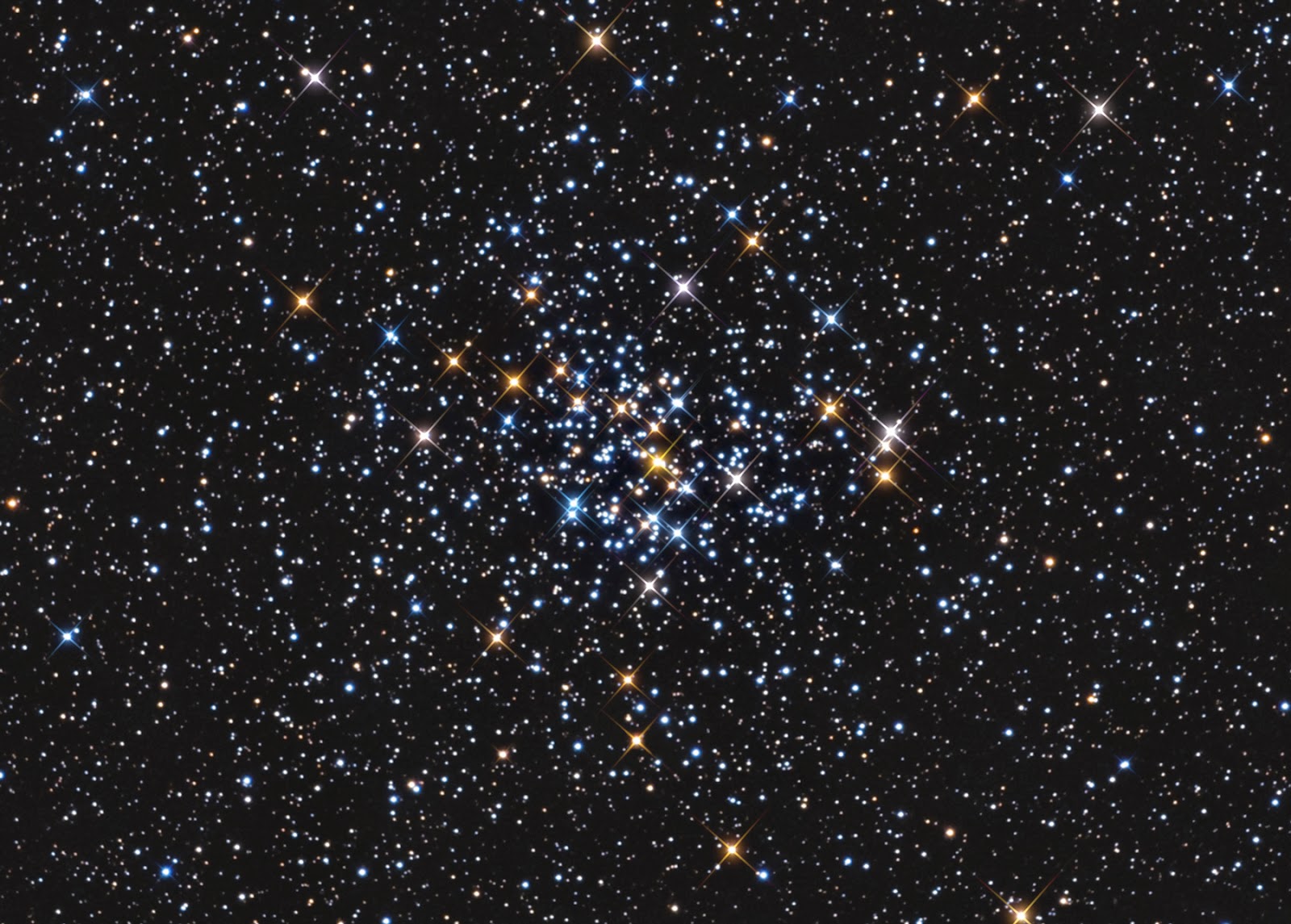
For the past two winters I've noticed some interesting posts on the AAVSO website forums from Mr. Bill Wilson in the UK. He's an experienced variable star observer who started looking at the cluster called Messier 37 (M-37) in that constellation. There's a red giant star that gleams near the center of this cluster called SAO 58521.It can be seen fairly well in this photograph of M-37 taken by Emil Ivanov that I also copied from the web:
Though SAO 58521 is listed as Constant by the AAVSO with little to no variability in brightness, Mr. Wilson has been observing and reporting very unusual "behavior" in two years of studying it through the eyepiece. VSX lists it at 9.2 magnitude, but he's reported it as bright as 7.7 and as dim as 10.6. What's more, he has also reported some very quick changes in brightness, with it rising and falling almost half a magnitude in the space of a few minutes. Wilson (by his own description in his posts) was reluctant to send this information to the web, since no model of red giant star structure allows for such rapid changes in brightness. However, he was convinced enough that this needed to be investigated by other observers that he ended up sharing it in the AAVSO forum. Some have stepped up to look at it and there has even been a CCD imaging run, but so far no one else seems to have confirmed Wilson's observations of rapid brightness changes.
Wilson's posts intrigued me last year, but bad winter weather and my job schedule pretty much grounded me from getting outside with the telescope. When he started posting about SAO 58521 again in late September, now that this part of the sky has started to come into view before dawn, I contacted him to let him know I'd try to observe it and see if I saw anything unusual.
The important thing about this kind of amateur astronomy is that one can't look through the eyepiece expecting to see something unusual, or the mind will take over, and convince you that unusual things are happening! During the turn of the last century, Percival Lowell observed Mars and sketched an intricate network of canals on the surface of that planet. He was convinced that he'd see canals, since he'd read about Schiaparelli observing Martian canals years before. Sure enough, he saw them. Unfortunately, it's been obvious since the start of the Space Age that Lowell was wrong. Mars has natural dry canyons winding around parts of its surface, but only one of these might have been large enough to have been mistaken for a canal by Lowell. There is no network of straight, artificial canals like he saw. His expectations biased his observing. Bias is also something I keep in mind when doing some of my Lunar Observing, since I'm checking some areas of the Moon for LTP. But if I go to the telescope, point it at the Moon, and expect to see unusual red glows or small temporary clouds, I'm sure I'll see them just like Lowell saw his canals!
It's probable that the brightness changes in SAO 58521 might not be real at all, but sort of an optical illusion since the star is embedded in a rich background of stars. It might be a trick of poor Seeing (the turbulence in the atmosphere that makes stars seem to twinkle). Mr. Wilson himself readily agrees with this. At the same time, his observations of unusual brightness changes in SAO 58521 warrant further investigation, and the others who have looked at it seem to agree that it's at least a star that shows some variability instead of being constant.
On Sunday evening September 21 I went to the Variable Star Plotter page on the AAVSO Website and generated this chart for SAO 58521. Comparison stars had already been added by chart team members that are 8.9, 9.9, 10.2, 10.5, and 10.9 magnitude. The suspected variable is marked with cross-hairs at the center of the cluster in the middle of the page. I waited for the next clear night to start observing it, and that came on the morning of Tuesday the 23rd.
(See Part 2 of Observing Notes)
For the past two winters I've noticed some interesting posts on the AAVSO website forums from Mr. Bill Wilson in the UK. He's an experienced variable star observer who started looking at the cluster called Messier 37 (M-37) in that constellation. There's a red giant star that gleams near the center of this cluster called SAO 58521.It can be seen fairly well in this photograph of M-37 taken by Emil Ivanov that I also copied from the web:
Though SAO 58521 is listed as Constant by the AAVSO with little to no variability in brightness, Mr. Wilson has been observing and reporting very unusual "behavior" in two years of studying it through the eyepiece. VSX lists it at 9.2 magnitude, but he's reported it as bright as 7.7 and as dim as 10.6. What's more, he has also reported some very quick changes in brightness, with it rising and falling almost half a magnitude in the space of a few minutes. Wilson (by his own description in his posts) was reluctant to send this information to the web, since no model of red giant star structure allows for such rapid changes in brightness. However, he was convinced enough that this needed to be investigated by other observers that he ended up sharing it in the AAVSO forum. Some have stepped up to look at it and there has even been a CCD imaging run, but so far no one else seems to have confirmed Wilson's observations of rapid brightness changes.
Wilson's posts intrigued me last year, but bad winter weather and my job schedule pretty much grounded me from getting outside with the telescope. When he started posting about SAO 58521 again in late September, now that this part of the sky has started to come into view before dawn, I contacted him to let him know I'd try to observe it and see if I saw anything unusual.
The important thing about this kind of amateur astronomy is that one can't look through the eyepiece expecting to see something unusual, or the mind will take over, and convince you that unusual things are happening! During the turn of the last century, Percival Lowell observed Mars and sketched an intricate network of canals on the surface of that planet. He was convinced that he'd see canals, since he'd read about Schiaparelli observing Martian canals years before. Sure enough, he saw them. Unfortunately, it's been obvious since the start of the Space Age that Lowell was wrong. Mars has natural dry canyons winding around parts of its surface, but only one of these might have been large enough to have been mistaken for a canal by Lowell. There is no network of straight, artificial canals like he saw. His expectations biased his observing. Bias is also something I keep in mind when doing some of my Lunar Observing, since I'm checking some areas of the Moon for LTP. But if I go to the telescope, point it at the Moon, and expect to see unusual red glows or small temporary clouds, I'm sure I'll see them just like Lowell saw his canals!
It's probable that the brightness changes in SAO 58521 might not be real at all, but sort of an optical illusion since the star is embedded in a rich background of stars. It might be a trick of poor Seeing (the turbulence in the atmosphere that makes stars seem to twinkle). Mr. Wilson himself readily agrees with this. At the same time, his observations of unusual brightness changes in SAO 58521 warrant further investigation, and the others who have looked at it seem to agree that it's at least a star that shows some variability instead of being constant.
On Sunday evening September 21 I went to the Variable Star Plotter page on the AAVSO Website and generated this chart for SAO 58521. Comparison stars had already been added by chart team members that are 8.9, 9.9, 10.2, 10.5, and 10.9 magnitude. The suspected variable is marked with cross-hairs at the center of the cluster in the middle of the page. I waited for the next clear night to start observing it, and that came on the morning of Tuesday the 23rd.
(See Part 2 of Observing Notes)
Tuesday, August 19, 2014
2014 Meteor Roundup So Far
Since I missed the Perseid Meteor Shower peak last week due to bad sky conditions and my work schedule, and since weather and other factors seem to lie in the way of me observing this shower as it fades away until next year, I decided to take a little time today and go over the notes I've kept so far in 2014. I wanted to tally the number of meteors that I've seen since the year began and the number of showers, both major and minor, that I've been able to detect. Here's what I've come up with; and though it might look impressive, experienced meteor watchers can see numbers like these on one good night, not 18 nights like I've had so far!
TOTAL METEORS SPOTTED SO FAR = 42
TOTAL METEORS BY SHOWER:
Sporadic (SPO) (No shower membership) = 15
Anthelion (ANT) (Year-round source) = 5
S. Delta Aquariid (SDA) = 5
Lyrid (LYR) = 4
Perseid (PER) = 3
Camelopardalid (CAM) = 2
Pi Piscid (PPI) = 2
July Pegasid (JPE) = 2
Alpha Capricornid (CAP) = 2
c-Andromedid (CAN) = 1
Sigma Capricornid (SCA) = 1
METEORS SEEN BY SESSION (asterisk * means that I reported my totals for that session to the I.M.O.)
1. AM Sunday March 16 (Unplanned Observation).
ANT = 1, Total =1
2. AM Sunday March 30 (Planned Observing Session).
ANT = 1, Total = 1
3. AM Sunday April 6 (Planned Observing Session).
SPO = 2, Total = 2
4. AM Thursday April 10 (Planned Observing Session).
SPO = 1, Total = 1
5. AM Wednesday April 23 (Planned Observing Session).
SPO = 1, LYR = 4, Total = 5
6. AM Saturday April 26 (Planned Observing Session).
SPO = 1, Total = 1
7. AM Monday May 19 (Planned Observing Session).
Total = 0
8. AM Friday May 23 (Planned Observing Session).
CAM = 1, Total = 1
9. AM Saturday May 24 (Planned Observing Session).
CAM = 1, Total = 1
10. AM Friday June 27 (Planned Observing Session).
ANT = 1, Total = 1
11. *AM Sunday June 29 (Planned Observing Session).
ANT = 1, CAN = 1, Total = 2
12. *AM Monday June 30 (Planned Observing Session).
SPO = 1, PPI = 1, Total = 2
13. *AM Friday July 4 (Planned Observing Session).
SPO = 3, SCA = 1, PPI = 1, Total = 5
14. AM Wednesday July 16 (Unplanned Observation).
JPE = 1, Total = 1
15. *AM Friday July 25 (Planned Observing Session).
SPO = 1, ANT = 1, JPE = 1, Total = 3
16. AM Monday July 28 (Planned Observing Session).
SPO = 1, ANT = 1, CAP = 1, SDA = 3, Total = 6
17. *AM Sunday August 3 (Planned Observing Session).
SPO = 3, CAP = 1, SDA = 2, PER = 2, Total = 8
18. PM Wednesday August 13 (Unplanned Observation).
PER = 1, Total = 1
There are still plenty of meteor showers coming from now through the end of the year. Hopefully I can keep getting experience watching and recording them, and get some good clear nights in which to do this.
TOTAL METEORS SPOTTED SO FAR = 42
TOTAL METEORS BY SHOWER:
Sporadic (SPO) (No shower membership) = 15
Anthelion (ANT) (Year-round source) = 5
S. Delta Aquariid (SDA) = 5
Lyrid (LYR) = 4
Perseid (PER) = 3
Camelopardalid (CAM) = 2
Pi Piscid (PPI) = 2
July Pegasid (JPE) = 2
Alpha Capricornid (CAP) = 2
c-Andromedid (CAN) = 1
Sigma Capricornid (SCA) = 1
METEORS SEEN BY SESSION (asterisk * means that I reported my totals for that session to the I.M.O.)
1. AM Sunday March 16 (Unplanned Observation).
ANT = 1, Total =1
2. AM Sunday March 30 (Planned Observing Session).
ANT = 1, Total = 1
3. AM Sunday April 6 (Planned Observing Session).
SPO = 2, Total = 2
4. AM Thursday April 10 (Planned Observing Session).
SPO = 1, Total = 1
5. AM Wednesday April 23 (Planned Observing Session).
SPO = 1, LYR = 4, Total = 5
6. AM Saturday April 26 (Planned Observing Session).
SPO = 1, Total = 1
7. AM Monday May 19 (Planned Observing Session).
Total = 0
8. AM Friday May 23 (Planned Observing Session).
CAM = 1, Total = 1
9. AM Saturday May 24 (Planned Observing Session).
CAM = 1, Total = 1
10. AM Friday June 27 (Planned Observing Session).
ANT = 1, Total = 1
11. *AM Sunday June 29 (Planned Observing Session).
ANT = 1, CAN = 1, Total = 2
12. *AM Monday June 30 (Planned Observing Session).
SPO = 1, PPI = 1, Total = 2
13. *AM Friday July 4 (Planned Observing Session).
SPO = 3, SCA = 1, PPI = 1, Total = 5
14. AM Wednesday July 16 (Unplanned Observation).
JPE = 1, Total = 1
15. *AM Friday July 25 (Planned Observing Session).
SPO = 1, ANT = 1, JPE = 1, Total = 3
16. AM Monday July 28 (Planned Observing Session).
SPO = 1, ANT = 1, CAP = 1, SDA = 3, Total = 6
17. *AM Sunday August 3 (Planned Observing Session).
SPO = 3, CAP = 1, SDA = 2, PER = 2, Total = 8
18. PM Wednesday August 13 (Unplanned Observation).
PER = 1, Total = 1
There are still plenty of meteor showers coming from now through the end of the year. Hopefully I can keep getting experience watching and recording them, and get some good clear nights in which to do this.
Saturday, August 16, 2014
AM Sunday, August 3, 2014 - Meteor Observing
Begin: 1:00 AM EDT (5:00 UT). End: 4:10 AM EDT (8:10 UT)
Location: Backyard patio at Home. Longitude = 86° 03' 01" W, Latitude = 39° 39' 35", Elevation = 255 meters.
Observed Showers:
Kappa Cygnids (KCG) 284° +58°
Alpha Capricornids (CAP) 308° -09°
Anthelion (ANT) 323° -12°
Delta Aquariids (SDA) 344° -15°
Perseids (PER) 034° +55°
(No plotting tonight, only visual counting.)
Details:
Period 1:
Time: 1:00 AM EDT - 2:05 AM EDT (0500 - 0605 UT Aug. 3)
Field: 330° +30° (Between Cygnus and Pegasus)
Teff: 1.050, F: 1.000, LM = 4.50 (roughly)
Meteor 1 - 1:00 AM (0500), CAP, 0.0 mag., Speed = 2, Wake seen, Glowing train lasted about 1 second, Whitish? Nice one!
Meteor 2 - 1:39 AM (0539), SDA, +1.0 mag., Speed = 2-3, Wake seen, No Train, Blue-White. Scudded along close to the East horizon.
Meteor 3 - 1:41 AM (0541), PER, +2.0 mag., Speed = 4, No Wake, No Train, No Color Noted. First Perseid of the season!
Period 2:
Time: 2:35 AM EDT - 4:10 EDT (0635 - 0810 UT Aug. 3)
Field: 0° +30° (Near Alpha Andromedae)
Teff: 1.083, F: 1.425, LM = 4.50 (roughly)
Meteor 1 - 2:56 AM (0656), Sporadic, +2.5 - +3.0 mag., Speed = 5, No Wake, No Train, No Color Noted. Like a very fast and faint point of light. If the path were traced back the radiant would probably be Far Western Pegasus or Eastern Aquila. Too fast to count it as an Anthelion.
Meteor 2 - 3:12 AM (0712), Sporadic, +2.0 - +2.5 mag., Speed = 4 -5, No Wake, No Train, No Color Noted. Originally in my recording I thought this could have been a Kappa Cygnid. However, the speed I estimated seems way too high for this and the radiant seems too far east; closer to the middle of Cygnus than the area between Cygnus and Draco. This meteor had a quick little flare right at the end after it seemed to end!
Meteor 3 - 3:26 AM (0726), Sporadic, +3.0 mag., Speed = 3, No Wake, No Train, No Color Noted. When traced back the radiant for this one would have been more in the "eastern wing" of Cygnus but not too close to where the Kappa Cygnid radiant lies. It was more between the "forelegs" of Pegasus and Cygnus.
Meteor 4 - 3:46 AM (0746), PER, +2.0 mag., Speed = 4, Wake seen, Glowing Train about one half second.
Meteor 5 - 4:06 AM (0806), SDA, 0.0 mag., Speed = 3, Wake seen, Glowing Train lasted about a second. Maybe the nicest meteor of the night besides the first one seen!
Notes:
The Waxing Moon (just a day away from First Quarter) was in Eastern Virgo between Spica to its West and Mars to its East. Moonset was around 12:05 AM (0505 UT Aug. 3). The Moon looked yellowish long before setting and rusty red when it was getting close to the horizon due to haze/smoke in the air. There were some scattered low clouds now and then before midnight and through 12:45 AM, but it was clear and cloud-free during the whole time I was outside. There may have been light fog in the air that slowly increased through the night. We had that ever-present murky haze in the sky that has plagued Central Indiana for several days, that I'm fairly sure is partly or mostly due to smoke high in the atmosphere brought in by weather systems from the US West Coast. The north and west sky were bright looking and a faint salmon color. This was probably from city lights reflected off fog and haze. The low horizons in general were more lit up than the rest of the sky.
My Limiting Magnitude estimate is based on being able to discern 4 stars in Area #7 (4.23) and 5 stars in Area #14 (4.73). Average of these two areas = 4.48. My Starry Nights planetarium program also lists Lambda Cygni as 4.50 magnitude and this star could usually be seen, faintly. This is rough but with the hazy conditions I'll stay with 4.50 mag.
I was in the lawn chair looking high in the east. I used the counting method only and the digital voice recorder. During the first session I was okay to start with just wearing jeans and a T shirt, but started to feel chilled by the end of the session. So during the second session I put on a hooded sweatshirt. There was little to no breeze all night but it was pretty dewy and I think this added to the chill. I had an all-sky chart with me printed from the AMS Website showing the radiant positions of the active showers.
1:00 AM - 67°F, Dew Point = 61°F, Humidity = 81%, Wind = Northwest at 6 mph, Pressure = 30.13"
4:00 AM - 65°F, Dew Point = 60°F, Humidity = 84%, Wind = Calm, Pressure = 30.12"
It was a noisy night! Lots of fire truck sirens nearby at the very start. There was a yard party going on two houses to my south, and it still hadn't quite wrapped up by the time I was finished. Loud kids and adults during the first session and loud intoxicated adults during the second. Awful generic hip hop music blaring from a radio during both sessions! Ugh! That yard was lit up from time to time and there was a bonfire burning, but I was sitting low enough that the lights were obscured by the privacy fence and the smoke seemed to go straight up and wasn't a problem. Besides that, there was a real chorus of singing insects out there; chirping Crickets and whirring and buzzing Long-Horned Grasshoppers including a few Katydids. There were a few Fireflies at least early on, but not many. Mosquitoes were a little bit of an issue, but I had plenty of repellent on. No aircraft were seen tonight while I was outside (we seem to have a "Sunday loll" here before dawn).
The Pleiades were visible from over the roof of our house from about 3:55 AM on, even though I was lying in the lawn chair near the patio edge, just a couple of feet from the ground. When I'd started tonight the Great Square of Pegasus was just clearing the roof from that vantage point.
Location: Backyard patio at Home. Longitude = 86° 03' 01" W, Latitude = 39° 39' 35", Elevation = 255 meters.
Observed Showers:
Kappa Cygnids (KCG) 284° +58°
Alpha Capricornids (CAP) 308° -09°
Anthelion (ANT) 323° -12°
Delta Aquariids (SDA) 344° -15°
Perseids (PER) 034° +55°
(No plotting tonight, only visual counting.)
Details:
Period 1:
Time: 1:00 AM EDT - 2:05 AM EDT (0500 - 0605 UT Aug. 3)
Field: 330° +30° (Between Cygnus and Pegasus)
Teff: 1.050, F: 1.000, LM = 4.50 (roughly)
Meteor 1 - 1:00 AM (0500), CAP, 0.0 mag., Speed = 2, Wake seen, Glowing train lasted about 1 second, Whitish? Nice one!
Meteor 2 - 1:39 AM (0539), SDA, +1.0 mag., Speed = 2-3, Wake seen, No Train, Blue-White. Scudded along close to the East horizon.
Meteor 3 - 1:41 AM (0541), PER, +2.0 mag., Speed = 4, No Wake, No Train, No Color Noted. First Perseid of the season!
Period 2:
Time: 2:35 AM EDT - 4:10 EDT (0635 - 0810 UT Aug. 3)
Field: 0° +30° (Near Alpha Andromedae)
Teff: 1.083, F: 1.425, LM = 4.50 (roughly)
Meteor 1 - 2:56 AM (0656), Sporadic, +2.5 - +3.0 mag., Speed = 5, No Wake, No Train, No Color Noted. Like a very fast and faint point of light. If the path were traced back the radiant would probably be Far Western Pegasus or Eastern Aquila. Too fast to count it as an Anthelion.
Meteor 2 - 3:12 AM (0712), Sporadic, +2.0 - +2.5 mag., Speed = 4 -5, No Wake, No Train, No Color Noted. Originally in my recording I thought this could have been a Kappa Cygnid. However, the speed I estimated seems way too high for this and the radiant seems too far east; closer to the middle of Cygnus than the area between Cygnus and Draco. This meteor had a quick little flare right at the end after it seemed to end!
Meteor 3 - 3:26 AM (0726), Sporadic, +3.0 mag., Speed = 3, No Wake, No Train, No Color Noted. When traced back the radiant for this one would have been more in the "eastern wing" of Cygnus but not too close to where the Kappa Cygnid radiant lies. It was more between the "forelegs" of Pegasus and Cygnus.
Meteor 4 - 3:46 AM (0746), PER, +2.0 mag., Speed = 4, Wake seen, Glowing Train about one half second.
Meteor 5 - 4:06 AM (0806), SDA, 0.0 mag., Speed = 3, Wake seen, Glowing Train lasted about a second. Maybe the nicest meteor of the night besides the first one seen!
Notes:
The Waxing Moon (just a day away from First Quarter) was in Eastern Virgo between Spica to its West and Mars to its East. Moonset was around 12:05 AM (0505 UT Aug. 3). The Moon looked yellowish long before setting and rusty red when it was getting close to the horizon due to haze/smoke in the air. There were some scattered low clouds now and then before midnight and through 12:45 AM, but it was clear and cloud-free during the whole time I was outside. There may have been light fog in the air that slowly increased through the night. We had that ever-present murky haze in the sky that has plagued Central Indiana for several days, that I'm fairly sure is partly or mostly due to smoke high in the atmosphere brought in by weather systems from the US West Coast. The north and west sky were bright looking and a faint salmon color. This was probably from city lights reflected off fog and haze. The low horizons in general were more lit up than the rest of the sky.
My Limiting Magnitude estimate is based on being able to discern 4 stars in Area #7 (4.23) and 5 stars in Area #14 (4.73). Average of these two areas = 4.48. My Starry Nights planetarium program also lists Lambda Cygni as 4.50 magnitude and this star could usually be seen, faintly. This is rough but with the hazy conditions I'll stay with 4.50 mag.
I was in the lawn chair looking high in the east. I used the counting method only and the digital voice recorder. During the first session I was okay to start with just wearing jeans and a T shirt, but started to feel chilled by the end of the session. So during the second session I put on a hooded sweatshirt. There was little to no breeze all night but it was pretty dewy and I think this added to the chill. I had an all-sky chart with me printed from the AMS Website showing the radiant positions of the active showers.
1:00 AM - 67°F, Dew Point = 61°F, Humidity = 81%, Wind = Northwest at 6 mph, Pressure = 30.13"
4:00 AM - 65°F, Dew Point = 60°F, Humidity = 84%, Wind = Calm, Pressure = 30.12"
It was a noisy night! Lots of fire truck sirens nearby at the very start. There was a yard party going on two houses to my south, and it still hadn't quite wrapped up by the time I was finished. Loud kids and adults during the first session and loud intoxicated adults during the second. Awful generic hip hop music blaring from a radio during both sessions! Ugh! That yard was lit up from time to time and there was a bonfire burning, but I was sitting low enough that the lights were obscured by the privacy fence and the smoke seemed to go straight up and wasn't a problem. Besides that, there was a real chorus of singing insects out there; chirping Crickets and whirring and buzzing Long-Horned Grasshoppers including a few Katydids. There were a few Fireflies at least early on, but not many. Mosquitoes were a little bit of an issue, but I had plenty of repellent on. No aircraft were seen tonight while I was outside (we seem to have a "Sunday loll" here before dawn).
The Pleiades were visible from over the roof of our house from about 3:55 AM on, even though I was lying in the lawn chair near the patio edge, just a couple of feet from the ground. When I'd started tonight the Great Square of Pegasus was just clearing the roof from that vantage point.
AM Friday, July 25, 2014 - Meteor Observing
When I was driving home from work between about 1:45 AM - 2:40 AM the sky was generally clear and the air felt cool. This had looked like my best chance to get in any meteor watching this week and I was encouraged by the conditions. It seemed like the air was dry; there hadn't even been any dew on the Civic when I started it up at the parking lot at the plant. However, weather can be a strange thing! When I was driving west on I-74 between the London Road exit and the Pleasant View exit I ran into a surprising bank of low fog. It wasn't widespread and I was out of it just seconds after driving into it, and it wasn't enough fog to make driving difficult, but it was definitely a surprise. Then, when I was on the far Southeast Side of Indianapolis and I was driving east on Indian Creek Road between Acton Road and Hickory Road, I ran into some more low fog. This started me thinking that maybe I wouldn't have any crystal clear sky after all.
Fortunately, the sky stayed fairly clear every time I checked while I was home, so I set up the lawn chair outside with the little table next to it, and I started getting ready for a meteor watching session. I had the charts outside, the little red light that I’d doctored up last night, and a mechanical pencil, before 3:30 AM. This is when I planned to start my session.
Just a minute or two after 3:30 AM, however, I was startled by a very strange sound that seemed to be coming from the easement or maybe the very back part of our backyard, or my neighbors' backyard to the north. It sounded like a cross between power equipment revving up and a nasty animal growl! I also thought that I heard peeping sounds as the louder sound kept going on and on. This was honestly like nothing that I've ever heard before! I wondered if a pit bull or stray dog was attacking something nearby. I went back in the house to grab the big halogen flashlight and I shone it around the back yard for five minutes, but saw nothing. The sound was gone. I was nervous about going back out not knowing what animal had made that noise, but I kept the flashlight with me on my lap in case I heard it again. I was also annoyed that now I had less time to do the meteor watching I wanted to do! I started back up at 3:45 AM and I was outside for the next hour and 25 minutes until dawn was getting too bright at 5:10 AM.
It was chilly enough for me to be wearing a sweatshirt and long pants. It was also dewy, and the lawn chair was a little bit wet. The dampness made it feel even chillier than it should have, and the back of my head was wet throughout the watch. The sky was clear but a little hazy due to light fog in the air. The wind stayed calm the whole time. Besides that unexplained noise that I heard when I tried to start observing I could hear some Crickets chirping and some whirring sounds from Long-Horned Grasshoppers, some local car traffic every now and then and some neighborhood dogs occasionally, and the hum of traffic a mile away on I-65 which picked up all night. Local traffic sounds also picked up as it got closer to dawn, and I heard birds singing a little after 5:00 AM. Trees were dripping dew and I could hear water drops falling now and then like very scattered and very light rain on the foliage. Between 4:50 AM through the end of the session there were a lot of low jet aircraft flying overhead from west to east. This was also a little distracting. I had no problems at all with mosquitoes, and fireflies were very few and far between tonight.
One other negative thing about this night was that my neighbor two houses down to the south had his floodlight on the whole time! I was fortunate that my lawn chair was low enough to the ground so that I didn't have this light in my eyes directly, but it was still a distraction because it was lighting up some of the trees to my south. I’m sure that it affected my night vision a little even though the wooden privacy fence on the south part of the patio blocked most of it.
By 4:45 AM through the end of the session the Pleiades were visible over the roof of our house, from my vantage point on the lawn chair, even though I was lying very low to the ground.
I started to see a hint of dawn in the Northeast part of the sky just after 5:02 AM. By 5:10 AM it was noticeable enough for me to cut my meteor watching short (the limiting magnitude had dropped below 5.0.) By the time I ended I could see the entire “pentagon” of Auriga over the roof of the house and the Hyades were also well above the roof and trees, all from the edge of the patio. By 5:20 AM it was getting bright enough that stars of 4th magnitude were very difficult to see, and by 5:30 AM only stars brighter than 2nd magnitude could be seen with some 3rd magnitude stars still visible close to zenith. I think the limit of any telescope observing this time of year would have to be about 5:15 AM - 5:20 AM and meteor watching was pretty much useless by 5:10 AM. To sum it all up!
Conditions at 4:00 AM - Temperature = 60°F, Dew Point = 54°F, Humidity = 80%, Wind = Calm, Pressure = 30.06”.
Conditions at 5:00 AM - Temperature = 59°F, Dew Point = 52°F, Humidity = 78%, Wind = Calm, Pressure = 30.07”.
SESSION - 3:45 AM - 5:10 AM (7:45 - 9:10 UT July 25)
Effective Observing Time = 77 minutes (1.2833 hours)
Center of Gaze = 00:00 +25 (Great Square of Pegasus and close to Alpha Andromedae.)
Cloud Cover Obscuration = High clouds covered the north between 3:45 AM - 4:00 AM and obscured about 20% of the sky. For the other 1 hour and 10 minutes of observing the sky remained clear.
Tree / Other Obscuration = 10% (Approximately. (1.275 for the tree cover for all of this session minus 0.0353 = 1.2397)
Visual Limiting Magnitude = 5.05 = 5 to 6 stars in Area 6 (Pegasus) (5.08 mag.), 6 stars in Area 7 (Cepheus) (5.12 mag.), 7 stars in Area 14 (Cygnus) (4.94 mag.).
3 Meteors Seen During This Session:
Meteor #1 - 4:05 AM (8:05 UT July 25). Anthelion (ANT). 4.0 magnitude. Speed = 3 (Average). No wake or train visible. This was a faint one that passed from between the “head” and “forelegs” of Pegasus into the Great Square. While I was outside I decided that this could well be an Anthelion, and the plot that I made for it (on Page 6 of the BRNO Atlas) also seems to bear this out, since it could have come from the Eastern Aquila part of that big spread-out radiant.
Meteor #2 - 4:17 AM (8:17 UT July 25). Sporadic (SPO). +1.0 magnitude. Speed = 4 (Swift). No wake or train seen. This was a nice bright meteor that blazed out of the corner of my eye from between Deneb and Cepheus through Cepheus, near Alpha Cephei and Beta Cephei. I plotted it on Page 1 of the BRNO Atlas. When I did this and extended the trail back, I realized that it could have been an Anthelion or one of the Capricornus-radiant showers, but the thing is, my view of it was so rough that I don’t trust the plot so much, especially extended back to another chart. For this reason I’m going to call it a Sporadic to be on the safe side.
Meteor #3 - 4:24 AM (8:24 UT July 25). July Pegasid (JPE). -2.0 magnitude or brighter. Speed = 4 (Swift). Had a train that glowed along the path for one or two seconds! This meteor sailed from between Triangulum and Perseus through Perseus. Unfortunately, I didn't see where it ended, since it went behind the roof of our house from where I was sitting! It was almost fireball level! When I plotted this meteor on Page 1 of the BRNO Atlas, I decided that the evidence was very good for it being a member of the July Pegasid shower, even though that shower peaked on July 10 and this was the last date that the AMS web page lists for that shower to be happening (July 25). The speed and direction and path length that I saw all seem to match up well. I’m at least 80% sure of it.
1 Notable Satellite Seen During This Session:
Satellite #1 - 5:02 AM (9:02 UT July 25). Bright and steady in brightness, about +1.5 magnitude (a little fainter than Deneb). This went right through the “forelegs” and “neck” of Pegasus heading north to south. I plotted the path of this one on Page 6 of the BRNO Atlas.
The diagrams below show the meteor positions plotted tonight along with a plot of the path of the satellite that I noted, done on the BRNO Atlas.
Fortunately, the sky stayed fairly clear every time I checked while I was home, so I set up the lawn chair outside with the little table next to it, and I started getting ready for a meteor watching session. I had the charts outside, the little red light that I’d doctored up last night, and a mechanical pencil, before 3:30 AM. This is when I planned to start my session.
Just a minute or two after 3:30 AM, however, I was startled by a very strange sound that seemed to be coming from the easement or maybe the very back part of our backyard, or my neighbors' backyard to the north. It sounded like a cross between power equipment revving up and a nasty animal growl! I also thought that I heard peeping sounds as the louder sound kept going on and on. This was honestly like nothing that I've ever heard before! I wondered if a pit bull or stray dog was attacking something nearby. I went back in the house to grab the big halogen flashlight and I shone it around the back yard for five minutes, but saw nothing. The sound was gone. I was nervous about going back out not knowing what animal had made that noise, but I kept the flashlight with me on my lap in case I heard it again. I was also annoyed that now I had less time to do the meteor watching I wanted to do! I started back up at 3:45 AM and I was outside for the next hour and 25 minutes until dawn was getting too bright at 5:10 AM.
It was chilly enough for me to be wearing a sweatshirt and long pants. It was also dewy, and the lawn chair was a little bit wet. The dampness made it feel even chillier than it should have, and the back of my head was wet throughout the watch. The sky was clear but a little hazy due to light fog in the air. The wind stayed calm the whole time. Besides that unexplained noise that I heard when I tried to start observing I could hear some Crickets chirping and some whirring sounds from Long-Horned Grasshoppers, some local car traffic every now and then and some neighborhood dogs occasionally, and the hum of traffic a mile away on I-65 which picked up all night. Local traffic sounds also picked up as it got closer to dawn, and I heard birds singing a little after 5:00 AM. Trees were dripping dew and I could hear water drops falling now and then like very scattered and very light rain on the foliage. Between 4:50 AM through the end of the session there were a lot of low jet aircraft flying overhead from west to east. This was also a little distracting. I had no problems at all with mosquitoes, and fireflies were very few and far between tonight.
One other negative thing about this night was that my neighbor two houses down to the south had his floodlight on the whole time! I was fortunate that my lawn chair was low enough to the ground so that I didn't have this light in my eyes directly, but it was still a distraction because it was lighting up some of the trees to my south. I’m sure that it affected my night vision a little even though the wooden privacy fence on the south part of the patio blocked most of it.
By 4:45 AM through the end of the session the Pleiades were visible over the roof of our house, from my vantage point on the lawn chair, even though I was lying very low to the ground.
I started to see a hint of dawn in the Northeast part of the sky just after 5:02 AM. By 5:10 AM it was noticeable enough for me to cut my meteor watching short (the limiting magnitude had dropped below 5.0.) By the time I ended I could see the entire “pentagon” of Auriga over the roof of the house and the Hyades were also well above the roof and trees, all from the edge of the patio. By 5:20 AM it was getting bright enough that stars of 4th magnitude were very difficult to see, and by 5:30 AM only stars brighter than 2nd magnitude could be seen with some 3rd magnitude stars still visible close to zenith. I think the limit of any telescope observing this time of year would have to be about 5:15 AM - 5:20 AM and meteor watching was pretty much useless by 5:10 AM. To sum it all up!
Conditions at 4:00 AM - Temperature = 60°F, Dew Point = 54°F, Humidity = 80%, Wind = Calm, Pressure = 30.06”.
Conditions at 5:00 AM - Temperature = 59°F, Dew Point = 52°F, Humidity = 78%, Wind = Calm, Pressure = 30.07”.
SESSION - 3:45 AM - 5:10 AM (7:45 - 9:10 UT July 25)
Effective Observing Time = 77 minutes (1.2833 hours)
Center of Gaze = 00:00 +25 (Great Square of Pegasus and close to Alpha Andromedae.)
Cloud Cover Obscuration = High clouds covered the north between 3:45 AM - 4:00 AM and obscured about 20% of the sky. For the other 1 hour and 10 minutes of observing the sky remained clear.
Tree / Other Obscuration = 10% (Approximately. (1.275 for the tree cover for all of this session minus 0.0353 = 1.2397)
Visual Limiting Magnitude = 5.05 = 5 to 6 stars in Area 6 (Pegasus) (5.08 mag.), 6 stars in Area 7 (Cepheus) (5.12 mag.), 7 stars in Area 14 (Cygnus) (4.94 mag.).
3 Meteors Seen During This Session:
Meteor #1 - 4:05 AM (8:05 UT July 25). Anthelion (ANT). 4.0 magnitude. Speed = 3 (Average). No wake or train visible. This was a faint one that passed from between the “head” and “forelegs” of Pegasus into the Great Square. While I was outside I decided that this could well be an Anthelion, and the plot that I made for it (on Page 6 of the BRNO Atlas) also seems to bear this out, since it could have come from the Eastern Aquila part of that big spread-out radiant.
Meteor #2 - 4:17 AM (8:17 UT July 25). Sporadic (SPO). +1.0 magnitude. Speed = 4 (Swift). No wake or train seen. This was a nice bright meteor that blazed out of the corner of my eye from between Deneb and Cepheus through Cepheus, near Alpha Cephei and Beta Cephei. I plotted it on Page 1 of the BRNO Atlas. When I did this and extended the trail back, I realized that it could have been an Anthelion or one of the Capricornus-radiant showers, but the thing is, my view of it was so rough that I don’t trust the plot so much, especially extended back to another chart. For this reason I’m going to call it a Sporadic to be on the safe side.
Meteor #3 - 4:24 AM (8:24 UT July 25). July Pegasid (JPE). -2.0 magnitude or brighter. Speed = 4 (Swift). Had a train that glowed along the path for one or two seconds! This meteor sailed from between Triangulum and Perseus through Perseus. Unfortunately, I didn't see where it ended, since it went behind the roof of our house from where I was sitting! It was almost fireball level! When I plotted this meteor on Page 1 of the BRNO Atlas, I decided that the evidence was very good for it being a member of the July Pegasid shower, even though that shower peaked on July 10 and this was the last date that the AMS web page lists for that shower to be happening (July 25). The speed and direction and path length that I saw all seem to match up well. I’m at least 80% sure of it.
1 Notable Satellite Seen During This Session:
Satellite #1 - 5:02 AM (9:02 UT July 25). Bright and steady in brightness, about +1.5 magnitude (a little fainter than Deneb). This went right through the “forelegs” and “neck” of Pegasus heading north to south. I plotted the path of this one on Page 6 of the BRNO Atlas.
The diagrams below show the meteor positions plotted tonight along with a plot of the path of the satellite that I noted, done on the BRNO Atlas.
Subscribe to:
Posts (Atom)